
Preserving Expertise, Expanding Opportunity
Strengthening APEX Accelerator Programs Through Knowledge, Capacity, and Continuity
BLUF: An APEX Accelerator's greatest asset is not its technology. It is the experience, judgment, and commitment of the counselors who help businesses pursue government contracting opportunities. As demand for assistance grows, the challenge is not simply collecting information about how the program runs. It is making sure the expertise built over years of counseling can be shared across a center, scaled as staff turnover, and carried forward into the next generation of program administrators.
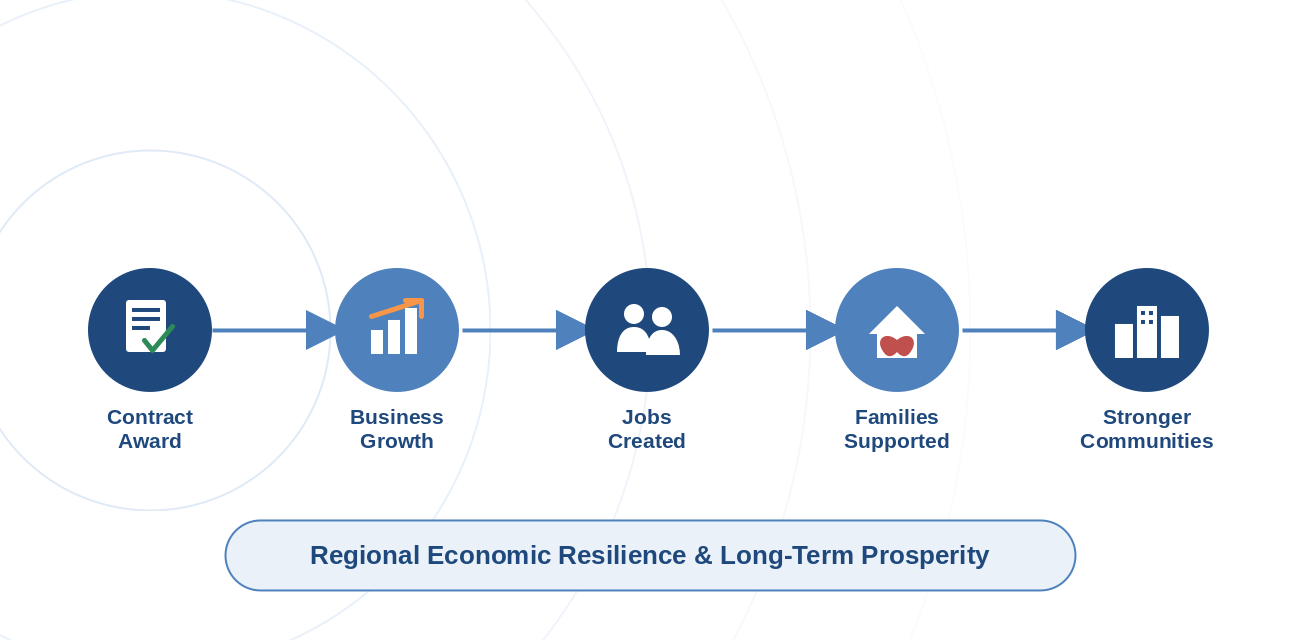
Every contract award creates a ripple effect. A win leads to growth. Growth creates jobs. Jobs support families. Families strengthen communities. Multiply that across the businesses a single center serves in a year, and the result is something larger than any one contract: regional economic resilience and long-term prosperity.
APEX Accelerators exist to make that ripple effect possible. Through one-on-one counseling, outreach, market research, certification support, and bid-matching, program staff help businesses navigate a federal, state, and local contracting landscape that can be genuinely overwhelming to approach alone.
The results of that work show up in familiar metrics: contracts awarded, businesses registered, jobs supported. But underneath those numbers sits something harder to measure and easier to lose. It is institutional knowledge, and it lives in specific places:
- The counselor who can tell, almost on instinct, which solicitations are worth a client's time and which are not.
- The hard-earned rules of thumb that keep a small business from making a costly mistake on its first set-aside bid.
- The years of pattern recognition built from walking hundreds of businesses through registration, certification, and capture.
Almost none of that knowledge came from a manual. It was built by doing the work: sitting with clients, making judgment calls, and learning from what worked and what didn't. That is both the program's greatest strength and its hardest problem to solve, because experience of that depth is very difficult to scale.
The opportunity in front of APEX program administrators is not simply to document what experienced counselors know. It is to turn that knowledge into organizational capability, so that new counselors, new centers, and the next wave of client businesses can benefit from lessons that would otherwise leave with a single retirement or resignation. Done well, this improves continuity, shortens onboarding, and keeps expertise creating economic opportunity long after the person who built it has moved on.
Economic Development Runs Through People
Program metrics tend to describe economic development in terms of dollars, contracts, and funding cycles. Those numbers matter, but underneath them, the work is about people: entrepreneurs deciding to take a risk, business owners trying to create something for their employees, and organizations trying to reach opportunities they can't yet see clearly on their own.
Every business a center serves has a different starting point. Some are pursuing a government contract for the first time. Others are trying to break into a new agency or expand past a single small-business set-aside. Many are simply trying to make sense of regulations, certifications, and acquisition processes that were never designed to be intuitive.
This is the gap APEX Accelerators fill. By helping a business understand its options, size up the real risk, and build a workable strategy, a good counselor turns uncertainty into a plan. Over time, that adds up to stronger businesses, stronger local economies, and, because contracts and jobs compound, opportunity that outlasts any single engagement.
The Knowledge Behind Every Win
Ask which businesses succeeded and which stalled, and most centers can answer instantly. What's harder to see is the reasoning behind that answer.
Every counselor builds judgment through repetition: which questions actually surface a client's real capability gaps, which certifications are worth pursuing given a client's size and history, which agencies tend to be a fit and which tend to be a dead end. Some of that judgment gets written down in playbooks or training decks. A lot of it does not. It lives in the people who've been doing the work long enough to recognize a pattern before it becomes a problem.
Every APEX center has someone newer staff go to when a hard question comes up. That's not a weakness in the organization, it's a natural byproduct of experience. The real risk shows up when that knowledge stays concentrated in one or two people instead of becoming something the whole program can draw on. When it's shared, everyone benefits: counselors get sharper faster, new hires get productive sooner, and clients get consistent guidance no matter who happens to answer the phone.
Why Good Intentions Still Fall Short
Most APEX Accelerator programs already recognize the problem. They write procedures, run onboarding training, stand up shared drives, and sometimes invest in case management systems meant to standardize how counseling gets delivered.
Even so, a lot of that effort doesn't land the way it's supposed to, not for lack of trying, but because of what gets lost in translation.
Expertise starts as tacit knowledge inside a person's head. It gets translated into a process, the process gets translated into a system, and at each handoff something goes missing. Experienced counselors leave things out of the documentation because the detail feels obvious to them. Business rules that everyone in the room already understands never make it into the requirements for the system meant to support the work.
The pattern that follows is a familiar one in mission-driven organizations: a process gets written up, a system gets built to support it, the resulting system may capture the documented process while overlooking exceptions, informal workarounds, and judgment-dependent decisions. A side spreadsheet appears to cover the rest. An email thread becomes the real record of a decision. New staff quietly learn that the official process is only part of the story, and the tribal knowledge the organization was trying to eliminate creeps back in through the side door.
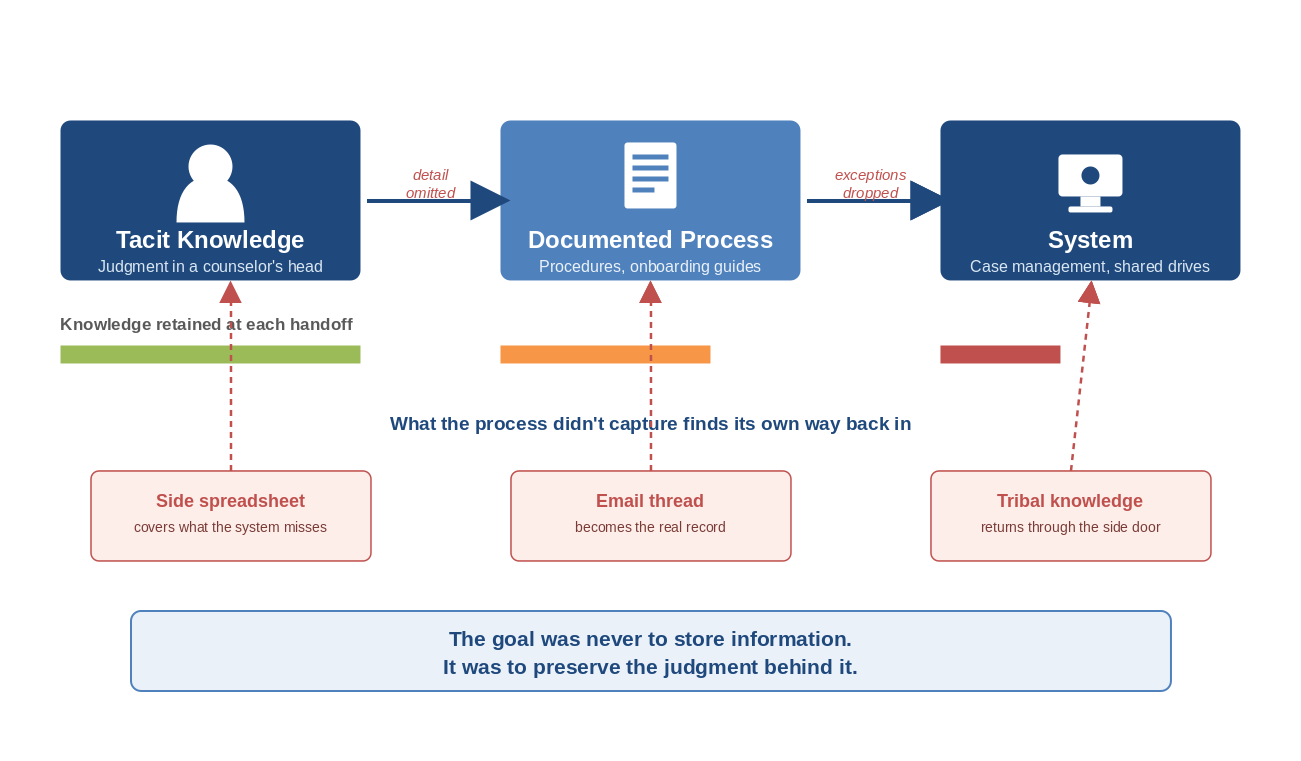
For a program built around long-term economic development, that's a real cost. The goal was never just to store information. It was to preserve the judgment and intent behind decisions that were made well.
Building a Foundation for the Next Decade
Every growing APEX Accelerator eventually hits a point where informal knowledge-sharing stops being enough. As caseloads climb and centers add staff, the knowledge that used to move through hallway conversations gets harder to pass along. New counselors need real ramp-up time. The most experienced staff become a bottleneck simply because they're the only ones who know the answer. Lessons that should belong to the program end up belonging to individuals instead.
This isn't unique to the APEX network, it shows up in government, nonprofits, and private industry alike. But the programs that come out ahead over the next decade won't be the ones that have accumulated the most information. They'll be the ones that get the most disciplined about turning that information into capability the whole organization can use.
That distinction is worth sitting with. Information can sit in a shared drive without doing anything. Capability is different, it's knowledge that gets applied consistently enough that outcomes don't depend on which counselor happens to be available that day.
For APEX program administrators, that's the real opportunity: not preserving a library of procedures, but making sure the expertise built over years of client work becomes something the whole center can draw on, long after any one counselor has moved to a new role.
Turning Counselor Expertise Into Organizational Capability
Most APEX Accelerator programs already have the knowledge they need. What they lack is a reliable way to capture it so it can be shared, scaled, and sustained across a center or a network of centers.
That's the gap ACC3 International built Alchemist AI Pro™ to close.
The usual approach to capturing institutional knowledge, sit an analyst down with a subject matter expert and write up what gets said, depends heavily on how good that one conversation happens to be. Even in well-run programs, there's no guarantee every assumption gets surfaced, every exception gets discussed, or every edge case makes it into the documentation. Details get missed. Things get assumed to be obvious. Some of the most important judgment calls never come up at all, because everyone in the room already takes them for granted.
Alchemist AI Pro™ is built around that specific failure mode. Instead of relying on a single conversation to capture everything that matters, it walks organizations through a structured process for eliciting, refining, and validating requirements, surfacing gaps, testing assumptions, and working through edge cases that don't usually come up in a standard intake session. The goal isn't just to document what was said. It's to systematically capture what actually needs to be understood for the work to be repeatable.
For an APEX Accelerator, that means requirements for new tools, workflows, or training materials that are grounded in how counseling actually gets delivered, not how someone assumed it worked from the outside. It's a stronger foundation for whatever the program builds next, and a practical way to turn years of counselor judgment into something the whole organization owns.
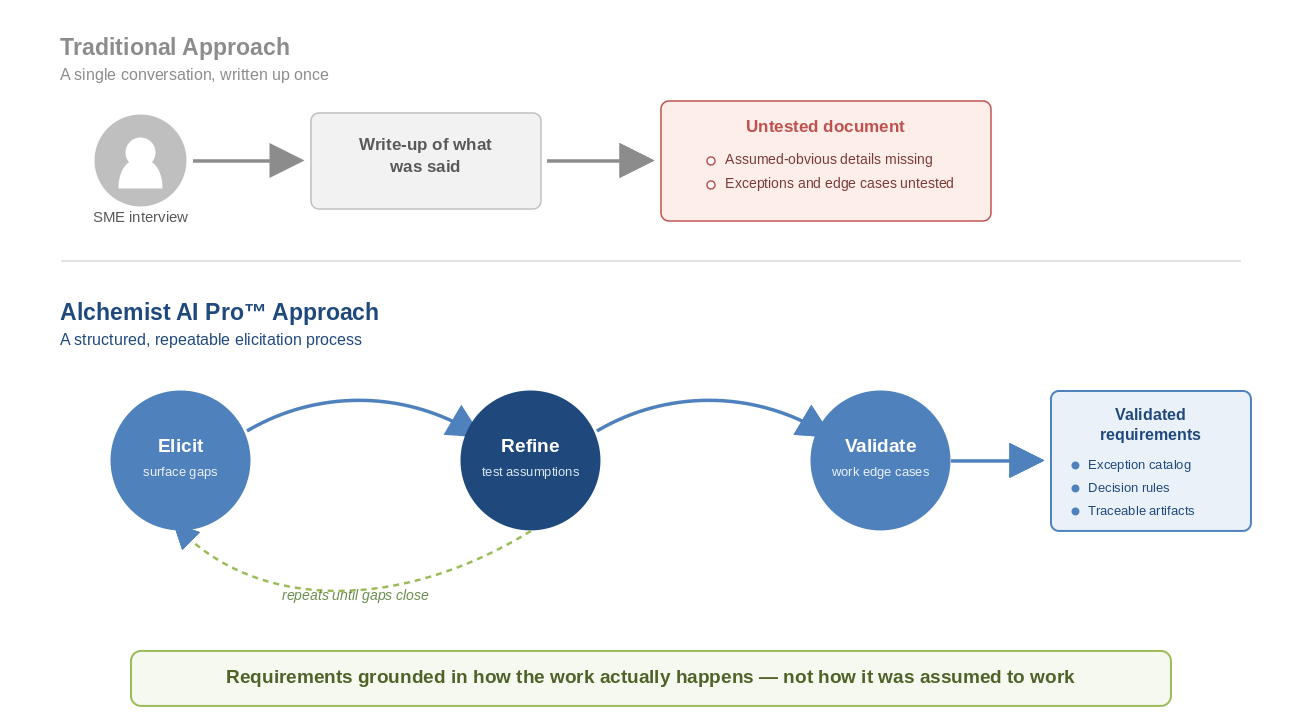
Table 1. Translating APEX Knowledge-Continuity Challenges into Alchemist-Supported Activities, Artifacts, and Measures
| Knowledge-continuity problem | Alchemist-supported activity | Resulting artifact | Measure |
|---|---|---|---|
| Exceptions remain undocumented | Structured SME elicitation | Exception catalog and decision rules | Percentage validated by senior counselors |
| New staff rely on informal coaching | Capture recurring scenarios | Role-based guidance and training requirements | Time to independent case handling |
| Case systems reflect only formal procedures | Workflow and edge-case analysis | Traceable system requirements | Reduction in off-system workarounds |
| Guidance varies by counselor | Validation against common scenarios | Shared acceptance criteria | Variance in case recommendations |
More information on the platform is available at acc3int.com/alchemist.
What This Could Look Like
Picture a new counselor joining an APEX Accelerator and getting access to more than a policy manual and a week of shadowing.
Picture that counselor inheriting years of accumulated judgment, the decision points, the near-misses, the "here's what actually happens with this agency" knowledge that used to take a decade to build on their own.
Picture center leadership with real visibility into where cases stall, where clients drop off, and where the program's own processes are quietly working against it.
Picture the next case management system or training curriculum getting built from requirements that reflect how counseling actually happens, not how it looks on paper.
That's the target: not just preserving information, but preserving understanding, turning expertise that used to live in a handful of people into a capability the whole program can rely on, long after any individual counselor has moved on.
Benefits to APEX Accelerator Programs
Programs that succeed at capturing and scaling expertise tend to see gains well beyond a tidier knowledge base.
Stronger continuity. Institutional knowledge survives staff turnover, retirements, and reorganizations instead of walking out the door with them.
Faster onboarding. New counselors reach full productivity sooner because they aren't starting from zero.
More consistent guidance. Clients get comparable advice regardless of which counselor picks up their case.
More capacity for client work. Staff spend less time reconstructing lost context and more time actually helping businesses win contracts.
Better-informed leadership. Program directors get a clearer view of where processes help and where they quietly get in the way.
Systems built for how the work really happens. Future tools and training reflect actual practice, not assumptions made from the outside.
Broader community impact. More businesses served, at a higher and more consistent standard, means more contracts, more jobs, and more durable economic activity in the communities each center serves.
Conclusion
The next decade of economic development work won't be won with more funding or more software. It will be won by the programs that get serious about capturing what their people already know and making it durable.
APEX Accelerators have already built something valuable: years of counselor judgment that helps businesses navigate a genuinely hard system and come out the other side stronger. The opportunity now is making sure that judgment doesn't stay locked in a handful of veteran staff, that it becomes part of the program's foundation instead.
Because behind every contract awarded, every business that made it through certification, and every job that followed is a counselor's judgment call that got made correctly. Preserving that judgment is, in the end, the same thing as preserving opportunity.
Next Step
ACC3 International welcomes the opportunity to run an executive briefing with APEX Accelerator leadership to talk through practical approaches for capturing institutional knowledge, building organizational capability, and setting a stronger foundation for the program’s next phase of growth.
References
DeLong, D. W. (2004). Lost knowledge: Confronting the threat of an aging workforce. Oxford University Press.
Harvard Business Review. (n.d.). Organizational learning and knowledge management research. Harvard Business Publishing. https://hbr.org
Liebowitz, J. (2009). Knowledge retention: Strategies and solutions. CRC Press / Taylor & Francis Group.
U.S. Department of Defense, Office of Small Business Programs. (n.d.). APEX Accelerators program overview. https://www.apexaccelerators.us
U.S. Office of Personnel Management. (n.d.). Succession planning and knowledge transfer guidance. https://www.opm.gov/services-for-agencies/workforce-succession-planning/succession-planning/
U.S. Small Business Administration. (n.d.). Government contracting and small business development resources. https://www.sba.gov/federal-contracting