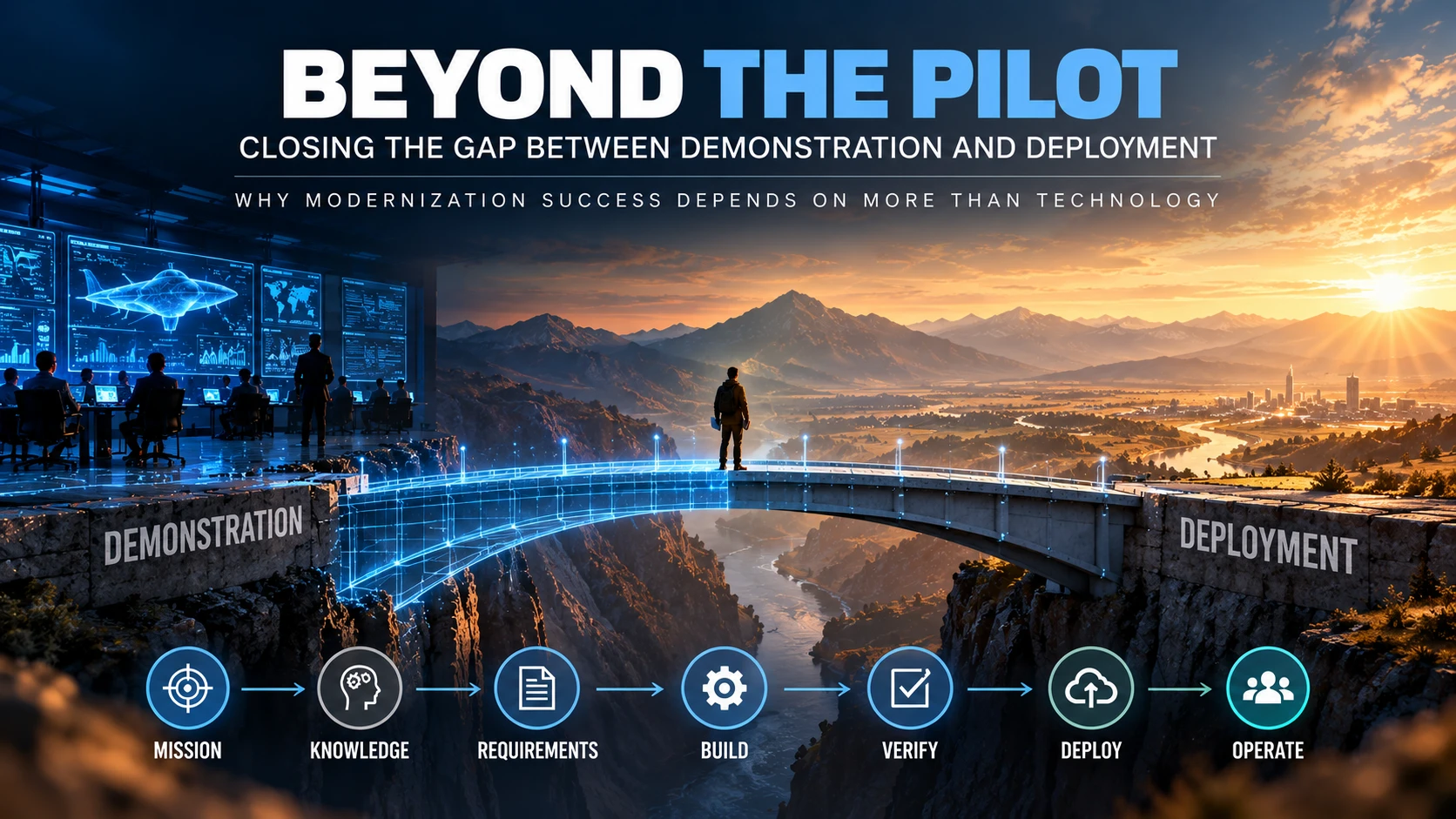
Beyond the Pilot: Closing the Gap Between Demonstration and Deployment
Why modernization success depends on more than technology
Abstract
Artificial intelligence (AI), automation, and modern software engineering have made it faster than ever to demonstrate new capabilities. Turning a demonstration into a capability that works every day is still slow, and that is where many modernization efforts stall. This paper introduces a seven-stage modernization lifecycle, identifies the handoffs where operational knowledge is most often lost, and poses five questions leaders should answer before committing to deployment. It argues that organizations must evaluate the delivery model that will carry a technology into operation with the same rigor they apply to the technology itself.
Introduction: The Demo Is No Longer the Hard Part
Demos rarely fail. Deployments often do.
A demonstration runs on selected data, a defined workflow, and a room full of people who want it to succeed. A deployment meets real users, security boundaries, legacy systems, incomplete data, and organizational policy, and it carries accountability for performance long after the demo team has moved on. AI-assisted development has made the first far easier to produce. It has done much less for the second.
The U.S. Government Accountability Office reached a similar conclusion in its 2026 review of 13 AI acquisitions at five federal agencies. The challenges officials reported included requirements definition, access to subject matter experts, and early testing and continuous evaluation (GAO, 2026). Most of these are not problems the technology itself solves; they sit in the organizational work around it.
The central question for modernization is therefore less about how quickly an organization can build something and more about how well operational intent survives the trip from concept to sustained use.
The Gap Between Demonstration and Operation
Modernization moves through seven connected stages:
MISSION → KNOWLEDGE → REQUIREMENTS → BUILD → VERIFY → DEPLOY → OPERATE
Mission defines the operational outcome. Knowledge captures the processes and constraints that shape the problem. Requirements translate that understanding into specifications. Build produces the capability. Verify confirms that it performs as intended. Deploy places it in the operating environment. Operate keeps it useful and secure with long-term sustainment as a main objective.
Most of the risk sits at the handoffs between stages. An experienced employee knows an undocumented exception. The requirements team never hears about it. Engineers correctly implement an incomplete requirement, and testing confirms technical compliance without revealing that the original need was missed. Every stage did its job, and the outcome is still wrong.
We call this translation loss: the erosion of operational context as information passes between people, processes, requirements, and technology.
Figure 1
The Modernization Lifecycle
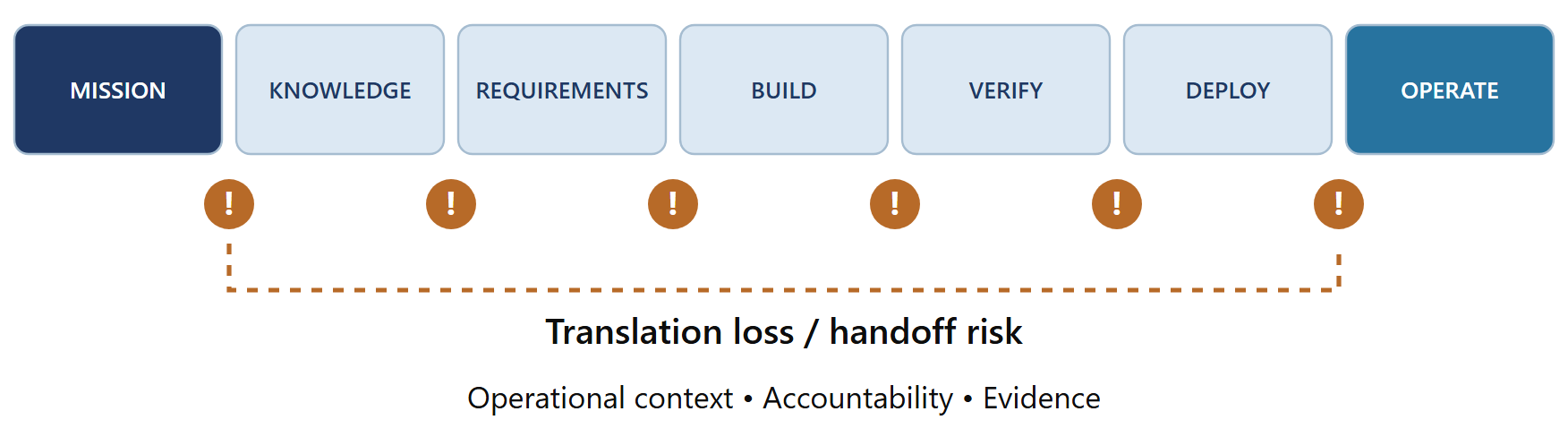
Note. Conceptual framework developed by ACC3 International. Each transition is a point where operational context, accountability, or evidence can be lost.
Translation Loss in Practice: The AMAD Test Stand
A recent case at Hill Air Force Base, Utah, shows what translation loss looks like inside a depot. The 530th Commodities Maintenance Squadron operates the only test stand able to validate the Aircraft Mounted Accessory Drive (AMAD), the gearbox that powers starters, generators, and hydraulic and fuel pumps, for both the F-22 Raptor and the B-2 Spirit. When overheated bearings caused repeated burnouts of the stand’s primary motor, the outage stretched for months. The stand’s original manufacturer had gone out of business, leaving no blueprints and no replacement parts (Johnson, 2026).
The capability came back because people did the requirements work the original documentation never captured: a full technical-requirements analysis found 30 deficiencies in the stand’s technical data (Johnson, 2026). The lesson is the one this paper is about: that knowledge was recovered the hard way, after a months-long outage, rather than kept current before one. That knowledge now underpins the sustainment of two strategic weapon systems. Whether it is written into formal technical data or stays with the individuals who solved the problem will decide whether the next failure is a one-week repair or another months-long gap.
The same pattern appears wherever modernization happens: manufacturers replacing enterprise systems, logistics organizations automating workflows, and commercial firms adopting AI. Reducing translation loss requires traceable links between operational knowledge, requirements, implementation, verification evidence, and intended outcomes.
Speed Changes the Constraint
For many organizations, writing software has historically been the main constraint on modernization. AI-assisted engineering is now accelerating coding, documentation, prototyping, and testing. Faster development, however, does not guarantee faster delivery.
The 2024 Accelerate State of DevOps report from Google Cloud’s DevOps Research and Assessment (DORA) program illustrates the gap. DORA estimated that every 25 percent increase in AI adoption was associated with a 2.1 percent gain in individual productivity, but also with a 1.5 percent drop in delivery throughput and a 7.2 percent drop in delivery stability. The researchers stressed the continuing importance of testing, user-centered practices, and disciplined delivery (DORA, 2024). The findings show association rather than causation, but the lesson holds: speeding up one activity does not speed up the system around it.
Consider an organization that cuts application development from six months to six weeks. If cybersecurity authorization, requirements approval, data integration, and operational acceptance still run on separate tracks, most of that time savings never reaches the end user. When technical execution accelerates, weaknesses in the surrounding delivery model become more visible.
The Department of Defense (2022) makes a similar point in its Software Modernization Strategy, which pairs investments in cloud and software factories with changes to workforce, acquisition, testing, and security practices. Governance remains essential. Its job is to produce timely, evidence-based decisions, and a governance process that produces only delay is failing at that job.
Five Questions That Determine Operational Readiness
Before committing to deployment, leaders should be able to answer five questions. Each maps to a stage of the lifecycle in Figure 1. Build is left out deliberately: as the previous section showed, it is increasingly the fastest part of the process.
1. Do we understand the operational problem? (Mission)
Technology selection should follow a clearly defined mission or business outcome. Automating a poorly understood process only accelerates its existing inefficiencies.
2. Have we captured what the organization actually knows? (Knowledge)
Critical expertise often lives outside formal documentation. Processes, exceptions, historical decisions, and workarounds may reside with a handful of experienced people, as the AMAD test stand recovery shows. Modernization is vulnerable whenever that knowledge cannot be transferred or independently validated.
3. Can we trace requirements to operational intent? (Requirements)
Each requirement should connect to the outcome it supports. Traceability should show not only that a function was implemented, but why it was needed and what evidence shows the need was met.
4. Can we prove the solution works under operational conditions? (Verify)
Verification must go beyond a successful demonstration. Realistic testing accounts for user roles, data quality, security boundaries, exceptions, system interruptions, and failure recovery. GAO’s AI Accountability Framework identifies governance, data, performance, and monitoring as the four principles of accountable AI implementation (GAO, 2021).
5. Is the organization prepared to operate what it builds? (Deploy and Operate)
Deployment requires defined ownership, user training, infrastructure, support responsibilities, change management, and sustainment funding. A working application without them creates new dependencies instead of solving old problems.
Modernization Requires a Delivery Decision
Answering those questions often exposes a problem that no technology selection can fix: the delivery model itself. Governance, acquisition, requirements, and deployment processes exist for good reasons and provide essential safeguards. When technical capabilities change quickly and those processes are never revisited together, they drift out of step with what the organization is trying to deliver. Effective modernization needs both speed and accountability.
Leaders should ask three things of their delivery model. Are requirements treated as static documents or as continuously traceable statements of operational need? Are cybersecurity and verification built in throughout development or concentrated at the end? Are lessons learned captured and applied to the next initiative?
On that last point, the federal record is weak. GAO (2026) found that the agencies it reviewed did not regularly collect and share lessons learned from AI acquisitions, in part because their policies did not require it, which leaves them exposed to repeating avoidable mistakes.
Organizations that preserve knowledge, integrate verification, and assign clear accountability are better positioned to turn technical advances into operational results. That requires a delivery model designed deliberately for the capabilities the organization now wants to adopt.
Conclusion: The Decision Before the Technology Decision
Modernization initiatives usually begin with decisions about platforms, vendors, and technical capabilities. Those decisions matter, but they are rarely the most consequential ones leaders make. Technology placed into an undefined delivery model runs the risk of carrying old inefficiencies forward. There is also increased risk that it creates new dependencies or, worse, never reaches its intended outcome.
Successful modernization depends on limiting translation loss at every handoff, from mission intent and institutional knowledge through requirements, build, verification, deployment, and sustained operations. Before selecting the next technology, leaders should ask whether their organization is prepared to take an honest assessment and ask the five questions.
The technology decision determines what an organization can build. The delivery decision determines whether that capability ever reaches operations.
References
Department of Defense. (2022). Department of Defense software modernization strategy. https://media.defense.gov/2022/Feb/03/2002932833/-1/-1/1/DEPARTMENT-OF-DEFENSE-SOFTWARE-MODERNIZATION-STRATEGY.PDF
DORA. (2024). Accelerate State of DevOps report 2024. Google Cloud. https://dora.dev/research/2024/dora-report/
Johnson, K. (2026, September 18). Keeping stealth airborne: 530th CMMXS restores vital B-2, F-22 testing capability. Hill Air Force Base. https://www.hill.af.mil/News/Article-Display/Article/4605315/keeping-stealth-airborne-530th-cmmxs-restores-vital-b-2-f-22-testing-capability/
U.S. Government Accountability Office. (2021). Artificial intelligence: An accountability framework for federal agencies and other entities (GAO-21-519SP). https://www.gao.gov/products/gao-21-519sp
U.S. Government Accountability Office. (2026). Artificial intelligence acquisitions: Agencies should collect and apply lessons learned to improve future procurements (GAO-26-107859). https://www.gao.gov/products/gao-26-107859