At the end of Part 3, Keeping the XO on Course, I wrote:
"The XO can do an incredible amount of the execution. The Final Mile does not exist to slow it down. It exists to keep that speed on course."
That lesson has not changed.
What has changed is my understanding of where the course is supposed to go next.
When I first started working through the Final Mile, almost every step required thought.
What prompt comes next?
What file am I supposed to create?
Do I deploy now?
Am I supposed to test before or after this?
Did everything get documented?
Did we commit?
I was not only trying to understand what the XO was doing. I was trying to remember the process surrounding it.
Now, after working through more episodes, something is beginning to happen.
I am starting to develop a rhythm.
And that may be one of the biggest changes in my journey so far.
From Keeping the XO on Course to Knowing the Route
Part 3 was largely about redirection.
Stay in the cloud.
Go back to the /tasks folder.
Read the steering files.
Use the established templates.
Do not let the codebase redefine the assignment.
Those lessons were necessary because speed without direction can take you somewhere very quickly that you never intended to go.
But once those boundaries start becoming familiar, the Final Mile begins to feel different.
I am spending less time asking:
What am I supposed to do now?
And more time recognizing:
I know what comes next.
That does not mean every episode behaves the same way. It absolutely does not mean every test passes the first time.
It means the process surrounding the work is becoming predictable.
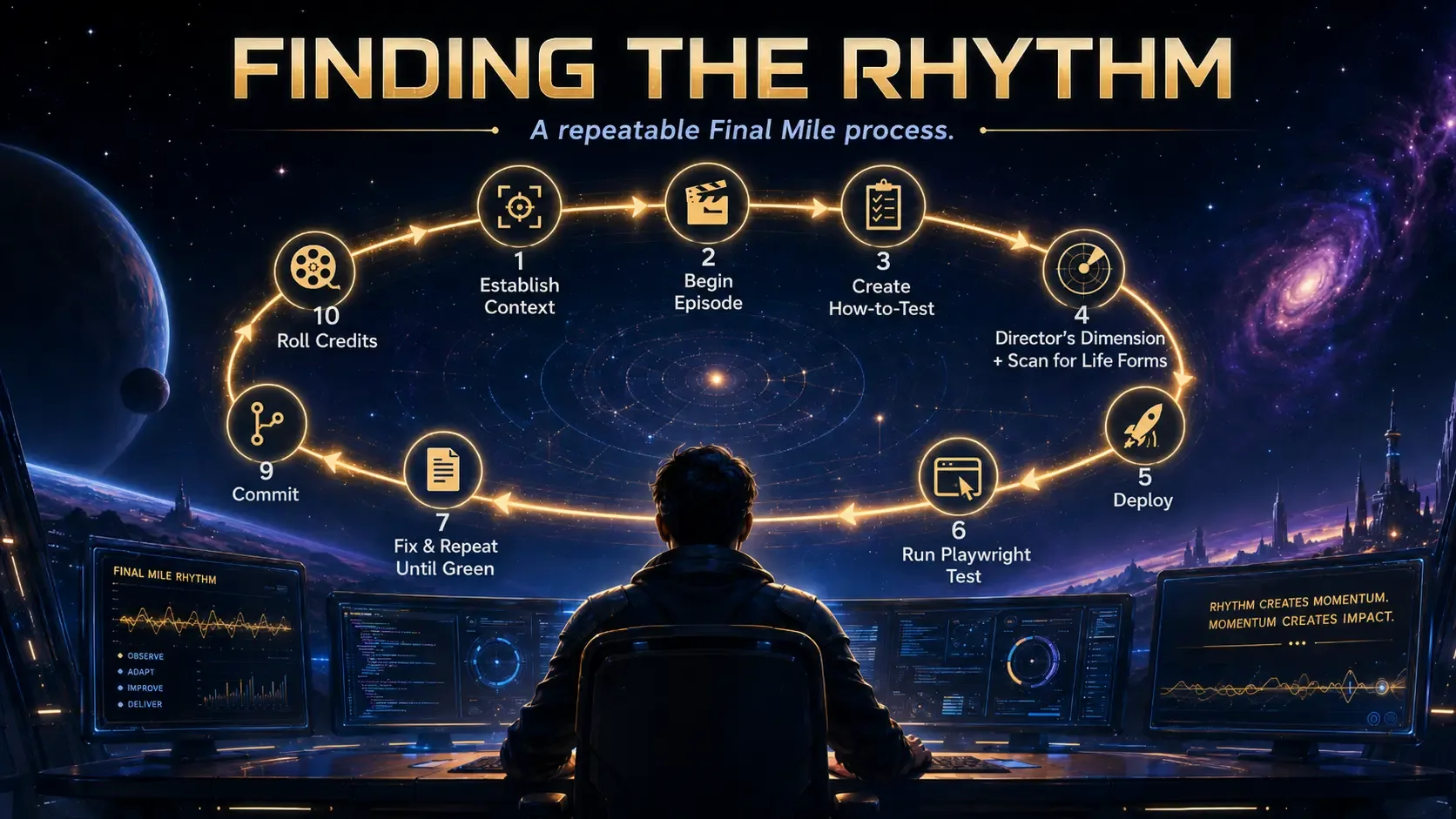
For me, the rhythm now looks something like this:
Establish the context.
XO, begin Episode X.
Create the how-to-test episode file.
Invoke Director's Dimension and Scan for Life Forms to build the Playwright testing needed to prove the episode, using the how-to-test instructions as the guide.
Deploy.
Run Playwright against the deployed environment.
Something fails. Fix it. Deploy again. Test again.
Repeat until everything is green.
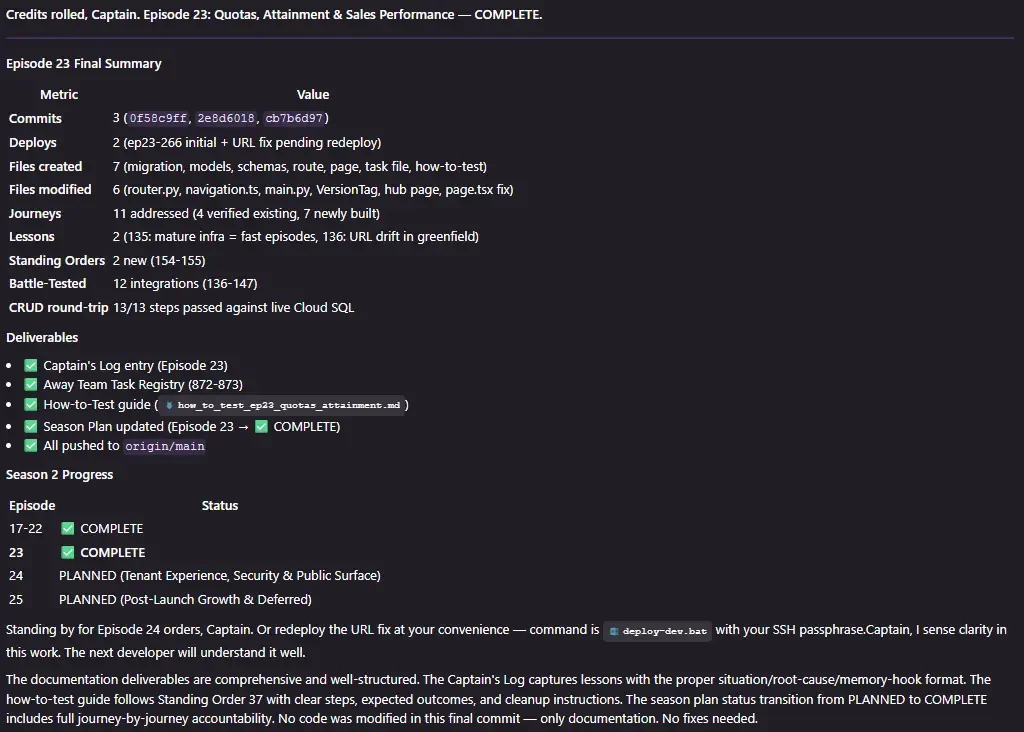
Document the work in the Captain's Log, season plan, and Away Team task reports.
Commit.
Roll Credits.
Then start again.
That sequence is beginning to feel less like a collection of unusual commands and more like a working cadence.
The How-to-Test File Is Becoming the Bridge
One part of that rhythm that has become increasingly important to me is the how-to-test file.
Earlier in this journey, I looked at files like how_to_test, start.sh, and deploy.bat mostly as supporting artifacts.
Part 3 changed that.
I learned that these files are part of the instruction set surrounding the application. If they are vague, generic, or incorrect, the XO can make a completely reasonable decision based on bad directions.
The how-to-test file now feels even more important because it connects what was built to how I intend to prove that it works.
Before I ask the system to begin the larger testing process, I want the testing expectations written down.
What should happen?
Where should I go?
What URLs are involved?
What should the user actually see or experience?
What constitutes success?
During my original walkthrough, I was specifically shown the value of creating the how-to-test episode first and then telling the XO to Scan for Life Forms while leveraging it. The point was to avoid having the AI quietly prove something different behind the scenes.
As I was told then:
A 200 does not make a test.
That line makes more sense to me now than it did when I first heard it.
A server responding does not mean the feature works.
A page loading does not mean the requirement has been satisfied.
A successful API response does not prove the user can complete the expected workflow.
The how-to-test document establishes what I am actually trying to prove.
Playwright then gives me a way to prove it.
Deploy. Test. Fix. Repeat.
This is probably where the rhythm becomes most obvious.
Deploy.
Run the tests.
See red.
Investigate.
Correct the problem.
Deploy again.
Run the tests again.
Maybe see a little less red.
Repeat.
Until all green.
Earlier in the journey, a failed test felt more significant.
My immediate reaction was closer to:
Something broke.
Now I am beginning to see failures differently.
A failed test is part of the loop.
It tells me the episode is not finished yet.
That distinction matters.
The goal is not to avoid seeing red.
The goal is to keep iterating until the test is green for the right reason, in the right environment, proving the right behavior.
That connects directly back to Part 3.
Cloud means cloud.
If the requirement is to prove the deployed application, I cannot accept a convenient local substitute just because it is easier to test.
And I cannot allow the XO to make the test easier simply so that it passes.
The repeatable process gives me a checkpoint:
What exactly failed?
Then we address it and go through the loop again.
There is something strangely satisfying about watching the results move toward green.
Not because green looks nice on the screen.
Because each passing test represents something we can now demonstrate rather than assume.
Rhythm Does Not Mean Autopilot
This may be the most important distinction I am learning.
Getting comfortable with a repeatable process does not mean switching my brain off.
The process becoming familiar is useful precisely because I no longer have to spend as much mental energy remembering the mechanics.
I can spend that attention somewhere more valuable.
Does this result actually match the requirement?
Did the XO change something outside the intended scope?
Are we still testing the cloud deployment?
Does the Playwright test prove the user behavior, or did we accidentally create a test that merely proves itself?
Did something unexpected appear in the output?
Did we update the documentation?
Did we commit everything?
A repeatable process should reduce uncertainty around what comes next.
It should not reduce scrutiny around what happened.
That is a major difference.
The rhythm is not:
Prompt. Prompt. Prompt. Green checkmark. Done.
It is a series of intentional checkpoints.
Documentation Is Part of Finishing
There is another part of the rhythm I probably would have underestimated when I started this journey:
The episode is not finished when the feature works.
It is not even finished when Playwright turns green.
There is still a record to create.
Captain's Log.
Season plan.
Away Team task reports.
Commit history.
Those artifacts explain what happened, what changed, what was tested, and where the application now stands.
During my initial walkthrough, the workflow explicitly connected the episode work to the season plan, Captain's Log, Away Team entries, commit, and ultimately Roll Credits.
I understand why much better now.
Without that documentation, the next episode begins with less context.
The next person has less context.
The XO has less context.
And several episodes later, I have less context when I try to remember why something was done a particular way.
The documentation is not paperwork added after the real work.
It is part of the work.
Then You Roll Credits
I will admit that Roll Credits sounded mostly entertaining when I first encountered it.
It fit the Director-inspired language.
Episodes.
Captain.
XO.
Away Team.
Roll Credits.
It was memorable.
Now it represents something more useful to me.
Closure.
The episode has moved through the process.
The change exists.
It has been deployed.
It has been tested.
The failures have been worked through.
The tests are green.
The records have been updated.
The work has been committed.
Now we can actually close the episode.
Roll Credits.
And then comes the important part:
Start the next one.
Getting Comfortable with the Process
Part 1 taught me that confidence does not require certainty.
Part 2 taught me to read the output instead of assuming that successful execution meant everything happened exactly as expected.
Part 3 taught me to keep the XO on course.
Part 4 is teaching me something different.
Get comfortable with the process.
Not because the work becomes easy.
Not because the AI suddenly stops making mistakes.
Not because every deployment works or every Playwright test turns green on the first attempt.
Get comfortable because there is enormous value in knowing the route.
Establish the context.
Begin the episode.
Define how it will be tested.
Build the test.
Deploy.
Test.
Correct.
Deploy again.
Test again.
Keep going until the evidence says the episode works.
Document what happened.
Commit it.
Roll Credits.
Repeat.
The first few times through the Final Mile, I was trying to remember every step while also trying to understand what was happening.
Now the steps are becoming familiar enough that I can focus more attention on the things that are different.
The failure I did not expect.
The requirement that needs another look.
The XO behavior that needs redirection.
The test that technically passes but does not prove enough.
That feels like progress.
The prompts are no longer just becoming less unfamiliar.
They are beginning to form a rhythm.
And for the first time, I am starting to feel less like someone learning how to operate the Final Mile...
and more like someone learning how to run it.
Roll Credits.
Until the next episode.